86-DOS 0.11 from Scratch

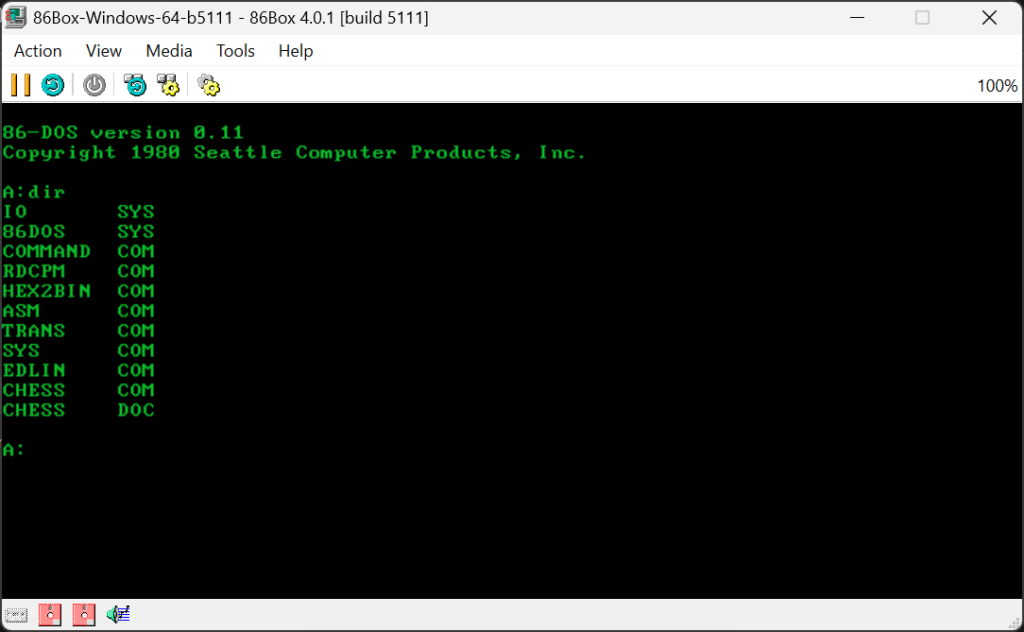
At the end of last year, a copy of 86-DOS 0.11 for the Cromemco 4FDC controller surfaced. It is the earliest released version of 86-DOS, the earliest operating system for the x86 architecture. Having done some legacy work dealing with real mode x86 before, I thought I could maybe challenge myself and build a copy of 86-DOS 0.11 from scratch.

Source Code Reconstruction

Clearly, to build 86-DOS from scratch, we need the source code. While the original source code would be preferable, good luck finding a copy. Earlier this year, I began a project to reconstruct the source code of 86-DOS 0.11 through disassembly, and I’ll briefly discuss it here. The goal of the source reconstruction project is to create source files that reassemble back to the original binaries and look indistinguishable from the original source code.

Before I begin, I want to list all the components of 86-DOS 0.11, in case you’re not familiar with them.

  • Boot Record (BOOT)
  • I/O System (DOSIO)
  • 86-DOS Kernel (86DOS)
  • Command Interpreter (COMMAND)
  • 8086 Assembler (ASM)
  • Chess (CHESS)
  • Line Editor (EDLIN)
  • Intel HEX To Binary Conversion Utility (HEX2BIN)
  • CP/M Disk Reader (RDCPM)
  • System Transfer Utility (SYS)
  • Z80 to 8086 Source Code Translator (TRANS)
Continue reading “86-DOS 0.11 from Scratch”

86-DOS 0.11 – IBM PC Port

Update

This port is now outdated. The latest ports of 86-DOS to the IBM PC are on GitHub and binaries may be downloaded from there too.

This is not a writeup, the port is still WIP. I’m just dumping whatever I’ve done here for people to see, because xmas and new year holidays are now over and I don’t want to devote any more of my very limited free time to projects like this.

A few days ago, Gene Buckle uploaded 86-DOS 0.11 and 0.34 to the Internet Archive. After about 2 hours of coding and debugging, perhaps the oldest surviving piece of x86 software booted on the (emulated) IBM PC:

Continue reading “86-DOS 0.11 – IBM PC Port”

Copying Execute-Only Binaries on Linux

I recently completed a C programming course at university. It was fun :). I guess the most interesting part was stealing the assignment solutions. Okay, just to be clear, I didn’t cheat.

Basically, we had programming assignments, and the lecturers provided compiled assignment solutions as demos for us to test our implementations against. When I heard that compiled solution demos would be given along with the assignments, I got pretty excited, as I had a few years of experience reverse engineering C code.

I asked one of the lecturers for permission to “steal” those demos and reverse engineer them, and I was given the go-ahead, which surprised me a bit. His original words were “we’ve made sure that you can’t just copy the executables and feed them into a reverse compiler, and if you are still able to do it, then there’s nothing much we can teach you in this course, but sure, you can try”. What could they have possibly done to protect their binaries?

Execute-Only Permissions

Binaries can be made execute-only, so that you only have execute permissions but not read or write permissions. Here’s an example of what an execute-only binary looks like:

-rwx--x--x 1 root  root  15776 Aug 21 11:13 test
Continue reading “Copying Execute-Only Binaries on Linux”

Reverse Engineering PC-DOS 1.00’s BIOS and Boot Sector

I wanted to get familiar with the IBM PC INT 1xH BIOS interrupts and explore how they’re actually used in practice, all in preparation for a challenge project. Reverse engineering the BIOS of PC-DOS seemed like the perfect exercise – the DOS BIOS handles all input and output for the DOS kernel and applications, so it naturally relies heavily on the PC BIOS INT 1xH interrupts. Plus, reverse engineering tends to give a much deeper understanding than just reading documentation online. Since I was already going to be digging into the BIOS, I figured I might as well reverse engineer the boot sector too.

So, which version of the PC-DOS BIOS and boot sector should I go with? To keep things simple, it made sense to start with the earliest version – PC-DOS 1.00. Conveniently, there was already a fully annotated disassembly of its BIOS and boot sector by Michael Steil. That said, this was primarily a learning exercise for me, so I avoided referring to his work while doing my own. As an added challenge, I wanted my disassemblies to produce binaries identical to the originals when assembled using the original assembler.

Reversing the BIOS

The first step was extracting the DOS BIOS from the diskette image. I opened the PC-DOS 1.00 disk image in a hex editor and noticed there’s no BIOS Parameter Block (BPB) seen in later FAT filesystems. I could’ve added a BPB, but I took the simpler route and extracted the BIOS directly using the hex editor. It’s the first file after the root directory. This also saved me from having to deal with system and hidden file attributes. I saved the extracted file as IBMBIO.COM and loaded it into IDA Pro.

Continue reading “Reverse Engineering PC-DOS 1.00’s BIOS and Boot Sector”